Buyer sourcing note
How to Specify Running Tabs and Reinforced Zones on Custom Running Socks
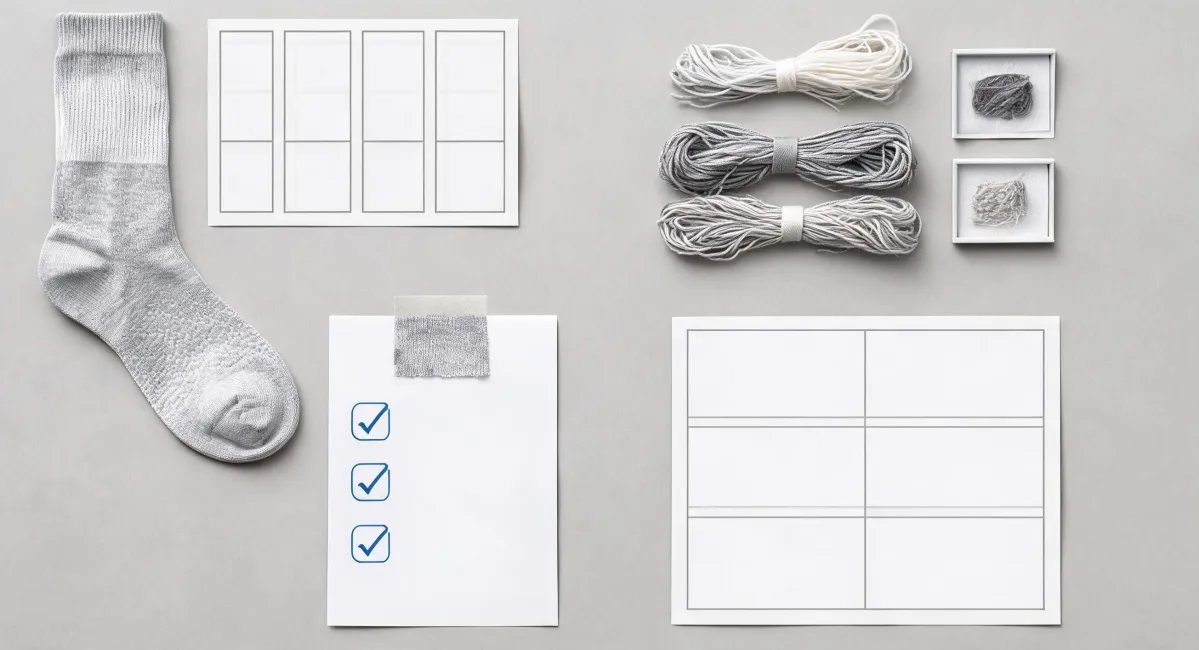
A sourcing team writes "running tab, reinforced heel and toe" into an RFQ, three suppliers quote, and the first samples come back looking like three different products. The tab sits at three different heights above the ankle opening. The reinforced heel covers a different area on each pair. Nobody misread the brief, because the brief never located anything, so each factory filled the gap with its own house pattern.
Treat the tab and the reinforcement zones as location, construction, and sample-approval decisions rather than catalog boxes. Sock Club's FAQ describes custom athletic ankle socks as carrying an additional running tab aimed at running crowds and race events, and its sports socks as having a reinforced heel, a reinforced toe, and added compression. That is a description of specific styles in one supplier's line, and it stays inside that boundary. It is not a category definition you can paste into an RFQ and expect five factories to read the same way.
Most Buyers Specify a Tab by Name Only
The word "additional" is doing real work in that FAQ line. It says the tab is an added pattern element on that supplier's ankle sock, layered onto whatever the crew sock already carried. It does not say how tall the tab is, how wide, where it starts relative to the heel seam, or what angle it takes against the ankle opening. Because the tab is added to a pattern rather than fixed by any shared standard, its position is a variable across suppliers, which means two factories can both deliver a running tab and hand you samples that cannot be laid side by side on the same table.
Price comparison is the first casualty, because a different tab geometry and a different reinforced area mean different yarn consumption and different knitting time, so the quotes were never measuring the same object. Sample review is the second, and the worse one, because there is no pass or fail line to point at. A reviewer looks at a tab and thinks it looks fine, and fine is not a specification.
My call as the buyer in that room is simple: a tab-only brief does not go out the door. Spend the extra day and require a zone map that locates the tab against the ankle opening, the heel seam, and the collar height of the shoe the sock is built for. There is one exception I would grant. If a candidate supplier returns its own measured part diagram, drawn by the pattern staff who will actually cut it rather than a template filled in to please you, and will sign the sample against that drawing, take their format over yours. A factory's own measured drawing carries more usable information than your template, because they have to live with it on every reorder.
Build a Supplier-Ready Spec Before You Request Quotes
Start the spec with the shoe, not the sock. Collar height and heel-cup shape decide where the tab can sit and how much of it stays visible when the foot is in the shoe, so get those two facts written down before anyone draws anything. Then fix the use case in one sentence: race day only, or training plus race. That sentence sets how much reinforcement and cushioning you are asking for, and it is the first thing a pattern room will ask you.
The zone map is a flat outline of the sock with the landmarks every factory reads the same way: heel seam, toe cap seam, ankle opening edge, and a centerline down the middle. Place the tab as a band with a width and a height rather than a point, and give its distance from the heel seam. Give the heel zone a start and an end measured from the heel seam, and the toe zone a start and an end measured from the toe cap seam. Bands and distances survive translation between factories; arrows and adjectives do not.
Write each feature as its own callout, tab, heel reinforcement, toe reinforcement, and compression if you are specifying it, so a factory can accept two and decline the third in writing instead of quietly dropping one from the quote. Send the identical brief with a revision number printed on every page to every candidate at the same time. One owner on your side, no verbal changes, and any change gets a new revision number and goes to all candidates at once. Skip that discipline and the comparison you are about to run measures nothing.
The check before any price arrives is the same for every candidate: they return your drawing annotated with their exceptions, or return their own drawing with the same landmarks marked. A quote that arrives without an annotated drawing is a guess, and it should be treated as one when you rank suppliers.
Place the Tab Against the Shoe Collar
Because the tab sits near the ankle opening, its position has to be tied to something that does not move with the yarn, namely the heel seam and the opening edge, and then to the shoe collar it will sit inside. The reason that second reference matters is that the tab is only judged when the sock is worn with the shoe. A flat-lay photo can hide whether the tab clears the collar or disappears under it, which means an approved flat-lay is not an approval of anything.
Ask for two things with the sample: a pattern callout that dimensions the tab from the heel seam, and a worn photo on the specified shoe in the size you will actually sell. A tab that clears the collar on a size small may sit under it on a size large, and the photo is how you find out before you place the order.
Define Reinforced Heel and Toe Zones by Function
The same FAQ sentence lists reinforced heel, reinforced toe, and added compression together on Sock Club's custom sports socks. Three features in one breath become one word in a brief, and one word is not reviewable. Split them into separate callouts with separate boundaries before the brief leaves your desk.
Because heel wear comes from contact with the collar edge and the heel cup, while toe wear comes from contact with the toe box, the two zones exist for different reasons and do not share boundaries. Measure the heel zone from the heel seam and the toe zone from the toe cap seam, and state what changes inside each zone: a denser knit, a different stitch structure, or an added panel. Those three changes look identical in a photograph and behave very differently inside a shoe.
A single reinforced note leaves the reviewer unable to say which zone changed or how it changed. That is the gap between a sample you can reject with a stated reason and a sample you argue about for a week and then accept anyway.
Why Reinforcement Can Tighten the Fit
Reinforcement and cushioning both add material or structure at a specific spot. Because a sock is a closed loop of stretch fabric around the foot, extra thickness at the heel or the toe consumes some of the available stretch, and the loss shows up as reduced give and higher pressure along the panel or seam edge. Same nominal size on the label, different fit on the foot.
That is why sample approval has to cover size-graded fit and left-right symmetry, not appearance alone. Check the smallest and the largest size in the run, and check that the two socks in a pair match each other. A pair that is comfortable on one foot and tight on the other will sail through a photo review and fail the person wearing it.
Keep the approved pattern on file, and keep it per size. Scaling moves zone locations even when nobody intends a change, so a medium drawing enlarged to a large usually drags the heel zone with it. If the only drawing you approved was a medium, that is the only thing you approved.
One caution about comfort language in general. Printful describes each pair of its custom socks as featuring a soft, cushioned sole that makes them suitable as athletic socks or everyday essentials. That is a comfort feature on stock sock styles. It says nothing about running performance or durability, and it should never be pasted into a reinforcement justification as if it did.
Approve Samples Against the Written Zone Map
Lay the physical sample on the approved flat drawing and compare boundaries at the heel seam and the toe cap seam, edge to edge, on both socks. Photograph the inside and the outside at a scale that matches the drawing, so the comparison still works after the sample leaves the room. Put the socks on the specified shoe and photograph the tab against the collar at the size you will sell.
Record every deviation in writing with a photo reference and the revision number it belongs to. The closure you want is a signed sample, the annotated photos, and the exact revision that sample satisfies, three artifacts pointing at one another. A signed sample with no revision number on it is a souvenir.
The sign-off covers where the material sits and how much of it there is, nothing more. Without a wear trial or a lab result in hand, durability is not part of what you approved, and saying so in the file protects whoever reads it next.
Who Should Not Use a Custom Tab Spec
If the requirement is a logo on a comfortable sock and nothing beyond that, a stock cushioned athletic sock with decoration does the job and skips the entire zone-map cycle. Building a tab specification adds drawing work, sample rounds, and a revision log, and it returns nothing if nobody is matching the sock to a particular shoe collar.
Build it when you will approve a physical sample against a written zone map and keep that map on file for the next run, because that file is the only reason a second order matches the first. The teams that skip it are buying socks. The teams that keep it are buying a repeatable product.

Jane Smith
I’m Jane Smith, a senior content writer with over 15 years of experience in the packaging and printing industry. I specialize in writing about the latest trends, technologies, and best practices in packaging design, sustainability, and printing techniques. My goal is to help businesses understand complex printing processes and design solutions that enhance both product packaging and brand visibility.