Buyer sourcing note
Getting Left and Right Pair Approval Right on Custom Running Socks
-
What Counts as a Custom Running Sock Pair
-
Mirrored Pair and Asymmetric Pair Differ
-
Why Bottom Text Breaks Pair Approval
-
Asymmetric Pairs Can Change the Order Count
-
A Skeptic Asks if Separate Approval Is Overkill
-
The Second Objection to Costly Asymmetric Pairs
-
One Sample Check Before Bulk Release
-
Pair Questions for the Supplier RFQ
Do left and right custom running socks need separate approval? Yes, for one of the two pair types — and that split is where first orders go wrong. A symmetrical pair, where one design is mirrored onto both socks, needs a mirror check on a single sample. An asymmetric pair, or any pair carrying text across the bottom, needs a named left approval and a named right approval before the sample is signed off.
Pair logic — not the artwork alone — sets how many samples you check, how you name the files, and how the supplier counts the minimum. Approve one sock and assume the second follows, and you get the order you asked for on paper and a different one in the carton.
What Counts as a Custom Running Sock Pair
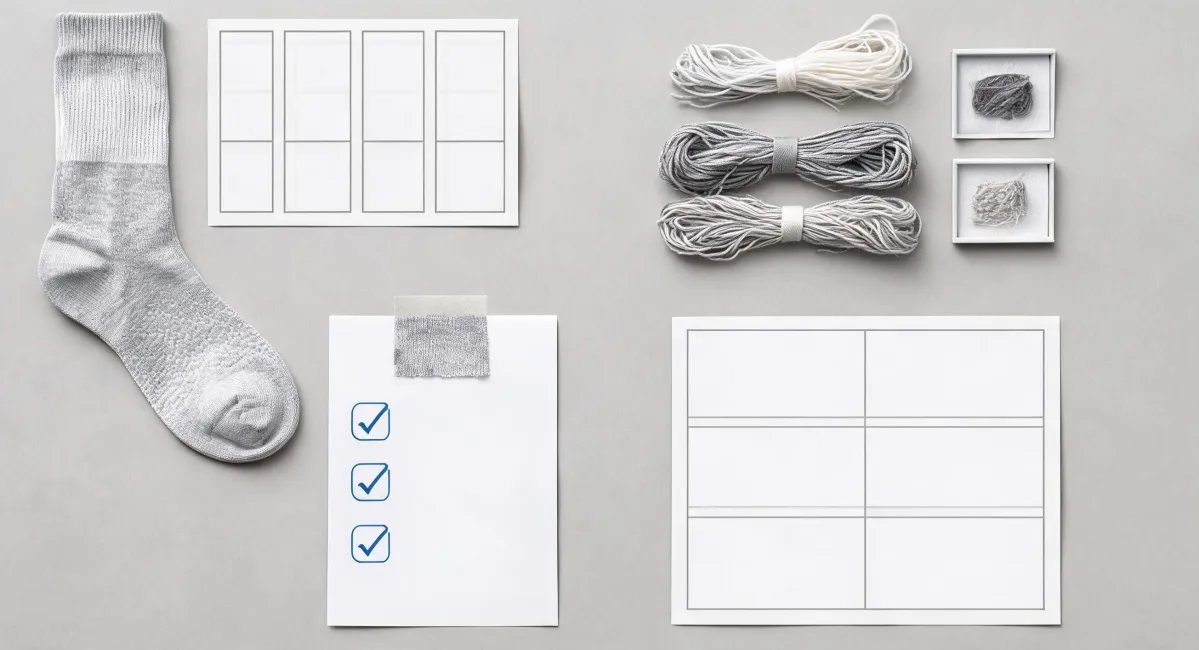
The approval unit is two finished socks and the files behind each one. That sounds obvious until you look at what usually gets signed: a flat mock-up, a photo of one knit sample, and a note saying the pair matches. A real pair approval names which sock is which, what each one carries, and what the supplier counts as a unit when it prices the order. Printful's guide for a matching pair treats the second sock as a mirrored copy of the first; Sock Club's FAQ treats mismatched pairs as two sock designs. Both describe the pair, which is the level a buyer has to approve at.
What travels with the pair matters as much as the socks. Per side you want the file name, a note on which way the design faces when the sock is on the foot, where the label sits, the size run you are approving, and the quantity basis the supplier used. Sign off two socks and a file list and the review becomes repeatable. Sign off one sock and a mood, and the second sample is a new conversation.
Mirrored Pair and Asymmetric Pair Differ
A mirrored pair is one artwork applied twice. Printful's instructions for a matching perfect pair are to select the Advanced template in Product templates and mirror the design. One file, one image, two orientations, and the check is whether the mirror actually landed rather than whether the artwork is good.
An asymmetric pair is two artworks. Sock Club states it can accommodate orders with mismatched pairs, which is a different production description from a mirrored copy: two designs, two file names, two approvals that can fail independently. That difference lands in your records. A mirrored pair needs one approval plus proof of the mirror; an asymmetric pair needs a left approval and a right approval, each tied to its own file, because approving the design as a whole approves half the order.
Why Bottom Text Breaks Pair Approval
Bottom-of-sock text is where pair approval breaks most often. On a flat file the word sits in the middle of a rectangle and reads normally. On the foot, the sole faces the floor and the reader meets it in a different orientation; mirror that same design onto the second sock and lettering running across the bottom can come out reversed on one side.
Sock Club lists pairings built on words across the bottom as a normal custom idea, and Printful's mirror step is what turns a single readable word into a directional problem. Neither example is a quality verdict on anyone's knitting. They are the reason a left and right text check belongs in the approval, aimed at the sock rather than at the screen.
Asymmetric Pairs Can Change the Order Count
Which mode you pick can move the minimum, and the count is rarely the number of socks you think you ordered. Sock Club publishes a 120-pair minimum for bulk custom socks with mismatched pairs and gives the reason plainly: there are technically two sock designs.
But treat that figure as one platform's published condition for that product, not a number to carry into a different quote. Ask a candidate supplier three things in writing: how it counts an asymmetric pair, whether the left and right files count as separate designs against the minimum, and what it charges for a two-design sample set. Those answers decide whether your order clears the minimum once or twice.
A Skeptic Asks if Separate Approval Is Overkill
A skeptic would say one sample sock is enough. Fine — for a mirrored pair it often is, and nobody needs two signatures to confirm that a copy is a copy.
The condition that breaks it is asymmetric or directional. When left and right carry different artwork, or when the design puts words across the bottom, one sock cannot show you the second orientation. You would be approving the side you can see and hoping about the side you cannot, which is how a reversed sole line reaches a bulk run. The stored examples support the two modes rather than a factory rule: one platform mirrors a design, another accepts two designs, and neither tells you what your supplier will do with your specific pair.
Approve per mode, not per habit.
The Second Objection to Costly Asymmetric Pairs
A skeptic would say two designs must cost twice as much, so asymmetric is the premium choice and mirrored is the budget answer.
The published material does not get you there. One platform ties its stated minimum to two designs; price is a separate line each supplier has to quote, and it may sit in setup, in the minimum, in sample fees, or in none of them. Keep those three apart when you compare quotes, because a supplier with a low unit price and a two-design setup charge can cost more at volume than one with a higher unit price and a single setup.
One Sample Check Before Bulk Release
What catches most pair errors is one labeled left sock and one labeled right sock drawn from the same approved sample set. Not two socks from two rounds, and not a photo. You want the pair the supplier says is the pair.
Hold the socks the way a foot would and read any bottom text in that orientation rather than flat. Then take each sock back to the artwork file named for that side and confirm the orientation note matches what you are holding. That is an acceptance habit, not a test standard, and it does not replace whatever inspection your own QC plan requires.
Pair Questions for the Supplier RFQ
The pair questions belong in the RFQ, before a quote becomes a comparison. Ask which mode the quote assumes, matching or asymmetric; how many artwork files are priced; which direction bottom text runs on each side; how the minimum is counted; what the sample fee covers and whether it is credited; how each sock is labeled through production; and how a change to one side is handled after approval.
Nothing here gives you a supplier's price, capacity, lead time, or certification, because none of that has been quoted or audited, and no sample has been physically tested. Those answers come from candidates in writing or they do not exist yet.
Before release, ask for one signed pair-approval sheet: the mode, the left and right artwork file names, and how the minimum was counted for that order. Hold the release if any field is blank, because the blank is where the second sock gets made from an assumption.

Jane Smith
I’m Jane Smith, a senior content writer with over 15 years of experience in the packaging and printing industry. I specialize in writing about the latest trends, technologies, and best practices in packaging design, sustainability, and printing techniques. My goal is to help businesses understand complex printing processes and design solutions that enhance both product packaging and brand visibility.