Buyer sourcing note
Custom Running Socks: A Fit Sample Plan for Real Size Ranges
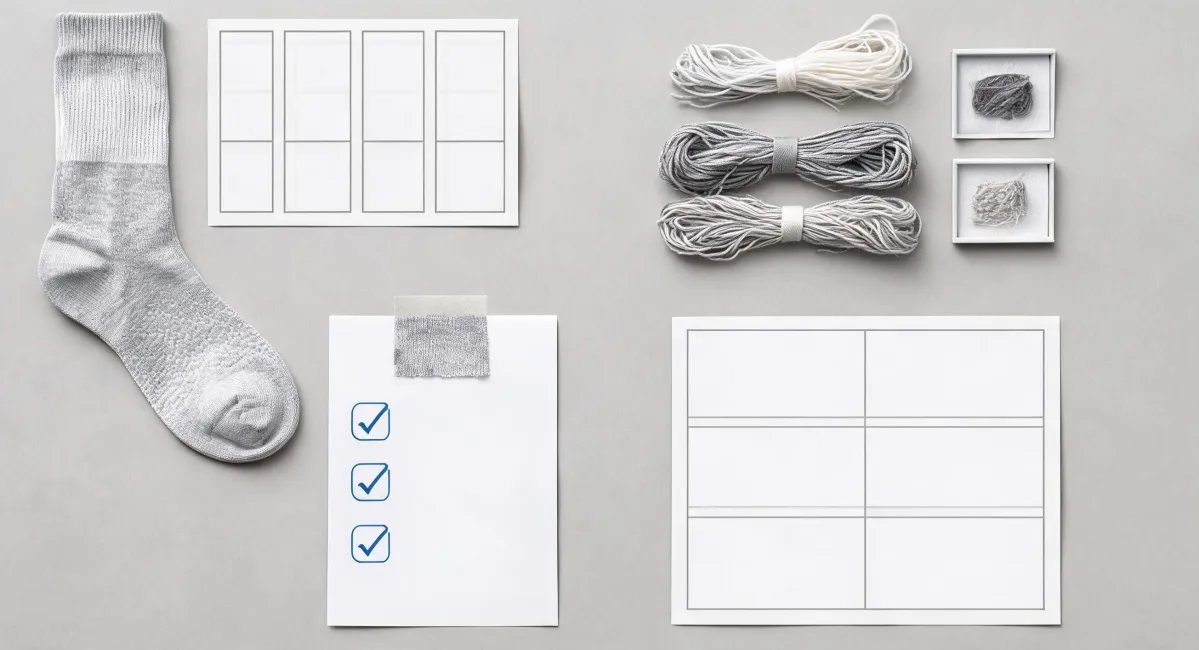
A custom sock supplier's FAQ puts a fact in plain sight: most clients who add a logo to custom branded or custom sports socks order the "One-Size-Fits-Most" option, which the same page calls adult medium. As a purchasing signal, that is clear. As a fit statement, it says almost nothing, because "most" describes who placed orders, not who wore the sock on a run.
That gap is where running-sock programs get expensive. A sock built for running is judged on the foot: a heel pocket that stays seated, an arch band that holds without biting, a toe box that leaves room, a cuff that neither rolls nor creeps down the calf. None of those show up in a size label. The plan below approves a graded fit sample across confirmed size bands plus a decoration sample, and it treats the adult medium default as the baseline pair rather than the whole answer.
Why One-Size-Fits-Most Is a Weak Fit Approval
Compressing a range into one adult medium is a supply-chain decision before it is a fit decision. Fewer size bands mean fewer knitting setups, lower minimums per band and less dead stock for whoever holds the inventory. For an order where the sock carries a logo and sells as merchandise, that trade is rational. It stops being rational once the sock has to perform on a foot that runs.
A running sock is a tension system. The elastane in the yarn pulls the fabric back onto the foot after each stride, the heel pocket has to stay behind the calcaneus, the heel bone, instead of sliding under it, the arch band has to grip the midfoot without cutting in, and the toe seam has to sit forward of the toenails. Each of those is a dimension, and each dimension moves with foot length and girth. "Adult medium" compresses whatever range a given supplier puts behind it into one word; the numbers underneath that word have to be requested from each candidate, in writing, with the measurement method attached. The label compresses a range that has to be measured, not assumed.
Build the Fit Sample Matrix on Day One
Suppose you are starting with no approved sample and a shortlist of candidate suppliers. Day one is not the day to request socks; it is the day to write the matrix every supplier will be asked to quote against, so the quotes are comparable before anyone knits anything.
Set the rows as the size bands each candidate can confirm, not the bands you assume exist. Set the columns as the variables that will decide approval: fit zones, knit construction, yarn content, decoration method and placement, sample fee, and a signature line.
Fit zones need measurement points behind them, or the sample review turns into opinion. Foot length runs heel to longest toe; ball girth wraps the metatarsal heads, the bones across the ball of the foot; instep girth crosses the top of the foot; cuff rib height and shaft circumference describe the collar. Each needs a stated method, because a girth measured flat on the table and a girth measured stretched over a foot are different numbers, and a supplier quoting the first against a buyer checking the second will fail acceptance for reasons neither side can see.
Knit construction belongs in the same sheet. Terry cushioning is looped pile knitted into the fabric; where it runs under the whole foot, the sock sits tighter in a shoe than a plain-knit version at the same girth. Needle gauge, the count of needles around the knitting cylinder, sets how fine the fabric is and how well small type resolves. Ask for it in the spec, not in a phone call.
Wear-Test Each Size Variant in Week One
If I were running this trial, I would take one pair from each confirmed size band into the first week and wear every pair twice, once on an easy day and once on a long day, writing the log entry within an hour of pulling the sock off. Fresh socks and fresh legs both flatter a sample, so the diary has to be filled while the memory of the run is still accurate.
A short set of fields carries most of the signal. Heel slip records whether the pocket stayed seated behind the ankle bone or migrated down into the shoe. Cuff roll records whether the rib folded over on itself. Toe-seam pressure records whether the seam ridge is felt across the toes, worst under a snug shoe. Arch bunching records fabric gathering under the midfoot. Post-run fit records how much the sock relaxed after sweat and load, against how it felt in the first minute.
Set the fail criteria before the first wear, not after. A pocket that ends up under the heel, a cuff that folds over, a seam that presses hard enough to notice on every step, fabric bunching under the arch — those are worth writing down; anything vaguer gets argued about at the review. Photograph the decoration on the same schedule, ideally right after each wash.
One wearer's log is directional, so a second tester on the same size bands makes the first week far more useful, particularly when the range spans narrow and wide feet. A size that fails on one foot shape can be fine on another, and the log should show which failure is the sock's and which is the foot's.
Compare Fit and Print Failures One Month Later
By the end of the first month the samples have been through repeated stretch and wash cycles, which is where fit problems declare themselves. Sort the log by size band and by fit zone, then look for where the failures cluster. Failures piling up at one end of the range point at grading: the pattern was graded on length but not girth, or the elastane percentage was held constant while the circumference changed. Failures in the same zone across every band point at construction: a heel pocket cut too shallow for anyone, a seam that was never flattened.
Print photos get the same treatment. Compare decoration across bands and note whether the artwork stretched, drifted toward the cuff, or lost small letters when the sock was pulled over a heel. Place the adult medium pair in the table as one row among the others and resist making it the control, because a baseline that passes tells you the middle of the range works, not that the ends do.
The review forces a choice. Re-sample the failing variant against a corrected spec, or reject the matrix and reopen the supplier question. Averaging a failure across the range and calling the sample approved is how a fit complaint becomes a return rate.
Which Print Checks Must Pass Before Bulk?
For centered designs or text, one established print-on-demand supplier advises a sample order before committing to volume, on the reasoning that samples let a buyer test quality and see how the artwork looks in real life. It is a low-cost checkpoint that is easy to skip.
The print review needs a short set of checks. Placement: where the artwork sits relative to the cuff edge and the ankle bone once the sock is on a foot. Legibility: whether small type survives the curvature of the leg and the resolution the gauge allows. Stretch distortion: what happens to the artwork when the sock is pulled over the heel, the widest point it will ever cross. Wear behavior: whether the decoration still reads after the trial and the washes that go with it.
If I were sequencing the first round, I would rather validate a centered logo or a short line of text than open with full-coverage artwork. A centered element isolates placement and type size from coverage and registration, and if either fails the fix is one file adjustment; a full-coverage layout adds those variables on top, so a failed round costs the whole design. The condition matters: when the design genuinely has to cover the sock, book a separate artwork sample and do not let a clean centered result stand in for coverage approval.
Passing these checks supports a sample approval. It does not certify how the print behaves across a season of washing; that question needs a longer trial or a supplier's own test report, and it is worth asking which one they have.
What Would Overturn the Fit Approval?
Approval is conditional, and the conditions should be written on the sign-off page before the samples arrive. Cancel approval if any size band in the approved range shows heel slip, cuff roll, toe-seam pressure or print distortion past the criteria agreed on day one. Cancel it if the supplier cannot confirm the size range, knit spec or decoration method in writing, because a sample that cannot be reproduced is a one-off, not a production standard. Cancel it if the physical sample does not match the approved sheet on measurement, yarn content or placement.
The last condition is the one buyers argue with, because the sample often feels close enough. Close enough is a judgment made with the sheet closed. Put the sheet on the table, measure the sample against it, and let the mismatch decide.
When approval is cancelled, re-sample the failing variant rather than widening the tolerance to fit what arrived. A second sample round has a bounded cost; a return rate that traces back to a widened spec does not.
What to Put in the Supplier Sample Request
The request should read like a form with open fields, because every number in it belongs to the supplier. Ask for unit price at the quoted quantity, minimum order quantity per size band, monthly capacity, quoted lead time and current certification status, and leave each answer blank until the supplier fills it. Anything pre-filled becomes an expectation nobody agreed to.
Attach a compact document set. A size-range chart with the measurement method stated for each point. A material and knit spec covering yarn content, elastane percentage and construction. The decoration file with placement and size marked in relation to the sock, not to a flat mockup. A sample fee and reimbursement term. An approval page with signature lines for fit, print and spec match.
Send the same matrix to every candidate. When quotes come back structured the same way, the comparison is about capability. When each answers a different question, the comparison is about who wrote a better email, and the sample round starts on an uneven field.
By the end of the sample round, the adult medium pair is back on the table: the label most of that supplier's clients order, now one approved row inside a graded range with a print sample beside it. If it and the other bands clear the wear log and the decoration checks, approve the range and start bulk on a spec that can be reproduced. If they do not, run the sample round again — cheaper by far than finding the problem on the returns report.

Jane Smith
I’m Jane Smith, a senior content writer with over 15 years of experience in the packaging and printing industry. I specialize in writing about the latest trends, technologies, and best practices in packaging design, sustainability, and printing techniques. My goal is to help businesses understand complex printing processes and design solutions that enhance both product packaging and brand visibility.