Buyer sourcing note
Custom Running Socks Care and Version Control for Sourcing Teams
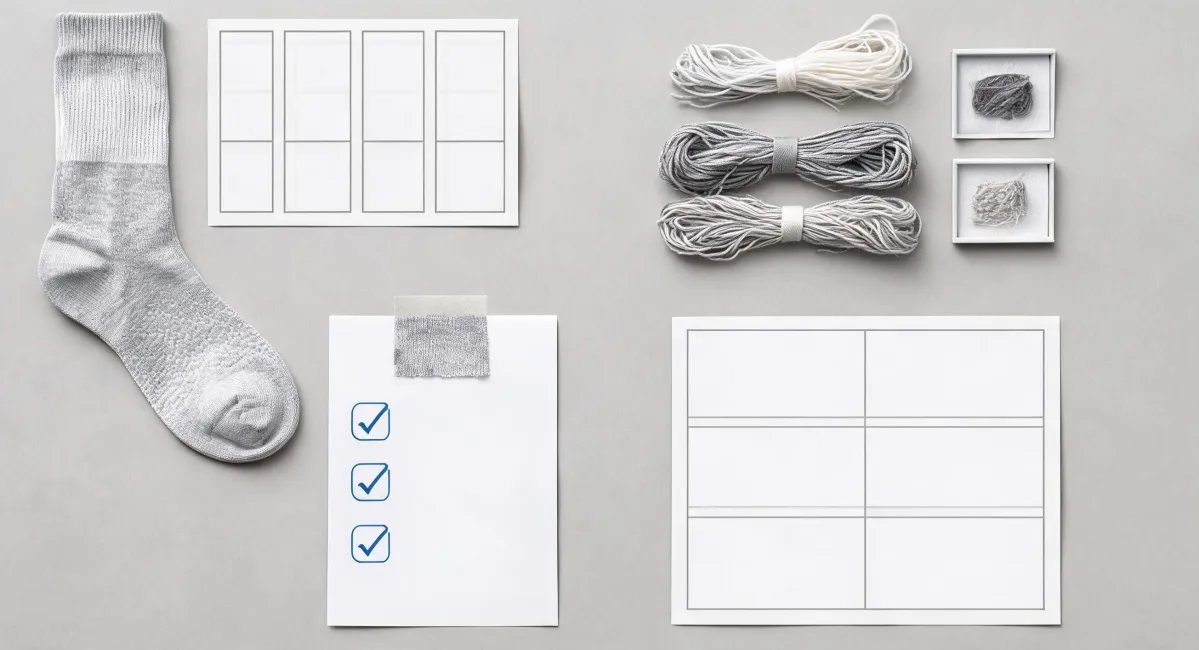
Two sourcing teams buy the same custom running socks from the same kind of supplier. The first leaves sampling with a care card tied to the quoted sock and a version log that pins style ID, size run, artwork file and the approved preview image. Six months later the reorder lands and nobody argues about it. The second leaves with chat screenshots and a memory of the sample. The second batch gets washed under a different rule, the print sits off register, and nothing in the file says which version was approved.
The difference is not the mill's marketing. It is whether care and version control were selection criteria before anyone paid for a sample. What follows is the screen I would run on candidates, the card and log I would make them fill, and the points where the extra paperwork is not worth the money.
Why Wash Care Outranks Durability Claims
A durability claim is the easiest line to put on a quote sheet and the hardest to check. You cannot confirm abrasion resistance, color retention across repeated washing, or compression hold from a supplier's brochure, and a sample photo does not confirm it either. With no test report in your own file, a durability promise is a sentence, not a specification.
A wash instruction behaves differently. It is a stated operating limit for one sock, and you can hold it against the exact item you are being quoted. Printful publishes one for its custom socks: machine wash with similar color clothes at no more than 30°C, no bleach, no dry clean. Read that as an example of the form rather than a rule for every running sock you will ever buy. What matters is that the sentence is concrete and attributed, so a buyer can put the same request in front of a second supplier and compare answers line by line.
So order the screen that way. Ask for the care route first. If the answer comes back as machine washable with no temperature, no bleach position and no dry-clean position, hold that supplier and resend the request with the fields written out. A candidate that cannot produce a temperature for the sock it is pricing is showing you how it will handle the rest of the specification. That pattern repeats.
Durability does not leave the conversation; it changes address. It becomes a sample and specification question: which yarn, which knit structure, where the heel and toe reinforcement sits, and what happens at the stated wash limit over repeated cycles. Those are items you resolve with whoever is knitting, at sample approval. Treat the durability claim as open until something in your own file supports it, and do not let a good slogan close it early.
Rank Suppliers on Care and Version Evidence
Three items decide the shortlist, and they come in a fixed order because a later one cannot repair an earlier failure.
First comes the exact care route for the quoted sock — not the category page, not the FAQ block, but the instruction that attaches to the item number you are pricing.
Second comes variant handling with a preview step before submission. Printful's custom sock flow lets a buyer create multiple variants across design, color and size and preview each one before the product goes to fulfillment or into a store. That is the mechanism you want to exist on the supplier side, because it is where artwork and size stop being a conversation and become a record.
Third comes a written design handoff. Sock Club's design builder tells buyers to read the instructions in the downloaded file before starting, and keeps its team available for questions along the way. A supplier that hands over a file with no instructions and no named contact has delivered an artifact, not a process.
Go with a candidate only when all three are documented for the sock you are quoting. Two out of three is a hold and a written follow-up question. One out of three is a skip, no matter how good the mockup looks.
Exclusions are easier to make than inclusions. A supplier that sends a polished rendering and nothing else fails the first item, because you have no care route to attach to the record. A supplier that writes gentle wash and will last, with no temperature, fails the same one. A supplier whose preview step exists but never produces a still image you can file fails the second, and you will find that out at the worst possible moment: after the bulk order is confirmed.
Two caveats before you use any of this. The provider examples describe those providers' own sock programs and design tools; they are not evidence about any factory's capacity, minimum order, pricing, delivery commitment or certification, and they say nothing about the mill behind your quote. And a preview step is a process control, not a performance guarantee.
Turn the Mill's Care Limit Into a Card
Take the supplier's stated limit and turn it into a one-page card that travels with the SKU. For the cited provider example, the card carries the ceiling exactly as written — the wash temperature in its stated unit, the bleach position, the dry-clean position — not a paraphrase of it. That line belongs to that sock and that provider. It does not transfer to a different knit, a different fiber blend, or a different vendor's blank, and copying it onto another product is how care cards become fiction.
Each field is either filled from a source or left open. The card carries a source field — the page or document the instruction came from, with the date you captured it. A bleach position and a dry-clean position each read allowed, not allowed, or not stated. Drying and ironing get a line only if the supplier says something about them. And the card carries the sock identifier: the style and size run it applies to.
That identifier is the field people skip and the field that causes the argument. A care card with no sock identifier is a care card for nothing. When a candidate cannot give you a care source, do not borrow another supplier's card to fill the hole. Ask for the written instruction and leave the field open until it arrives. An open field is honest and visible in the file. A copied rule looks complete and fails quietly, months later, at the washing machine.
Log Style, Size, and Artwork Separately
The log is separate from the card because the two change for different reasons. Care changes when the construction changes. Version changes when the design or the size set changes. Merge them and one approval overwrites the other's history, which is exactly the failure you were trying to prevent.
Seven fields hold the line: base sock or style ID, size run, colorway, artwork file name with its version marker, the approved preview image, the approval date with the name of whoever signed it, and the care-card version it links to. None of them is optional if a reorder is plausible.
Three rules keep the log usable. A requested change opens a new row; the approved row is never overwritten. The preview image attached to the approval is the one in the file, not a later screenshot pulled from a chat thread. And when the supplier cannot give a stable style or artwork ID, record that as a gap and let it weigh on the sample decision, because a log keyed to a number that drifts between orders is not a log.
The design handoff sits inside this log. Take the supplier who hands you a design file and tells you to read what is inside it: that instruction is only worth something if a named person answers follow-up questions in writing. So ask what is in their file, who answers questions about it, and what happens when artwork needs a revision after approval. If the answer is that the designer will sort it out, you have found the weakest row in the log before a single sock is knit.
Decide Sample Approval With Four Gates
At sample approval you are not judging a sock. You are judging whether the file behind the sock is complete enough to repeat. Four gates, in order.
Care first. If the candidate gives a care source for the exact sock in your hand, move to the next gate. If not, hold the approval and request it in writing; a verbal wash instruction is not a substitute, because nobody will remember it at reorder time.
Version second. When the style, artwork and size rows match the approved preview exactly, go forward. When any field is missing, or the preview on file is a different image from the one you signed off, hold and reconcile before anything else happens.
Handoff third. If the design-file instructions were actually read and the vendor answers your questions in writing, go. If you are the one guessing how their process works, skip the vendor rather than the step; a supplier who cannot describe its own handoff will not describe a deviation either.
Reorder logic fourth, and this is where the money decision happens. If a second production run is likely, require the version log as a condition of the order. If this is a genuine one-off with no artwork change, accept the lighter record and write down that you accepted it. The trade-off is a smaller file against a thinner safety net, and both are defensible once you have named them.
One boundary holds across all four gates. A sample photo proves appearance, nothing more. It is not evidence of durability, antibacterial behavior, UV performance, injury prevention, or any comparison against another sock, and no gate above should be read as producing that evidence. Those questions need testing you commission or documentation you collect, not a line in a procurement checklist.
Skip the Cheap Quote When Records Fail
Here is the plain trade-off. The documented route costs attention and narrows your shortlist, and it may cost more per unit. What it buys is a reorder that still matches the approved care card and the locked version log long after the sample is gone and the person who approved it has changed jobs.
If your team runs seasonal kits with repeat orders and artwork that gets refreshed, go with the candidate that shows a care source plus locked variants, even at a higher quote. If it is a single small run with no reorder and no artwork change, skip the full log and keep the care card plus one approved photo. Paying for version control where no reorder risk exists is just paperwork with a markup.
When a supplier cannot produce a wash limit for the sock it is quoting, that's the tell. It is not a gap you fill in later. The quote may still be the cheapest number on your screen, and it may still be the wrong one to sign, because the first thing to break at reorder is not the yarn — it is the record. No paperwork, no shortcut: the discount you take today gets repaid in the batch you cannot prove was wrong.
Decide what you are buying before you compare prices. A one-off run justifies a light file. A reorder product justifies the care source, the locked version log and a shortlist that lost a few names along the way. The quote you cannot document is not the safe choice; it is the cheap one.

Jane Smith
I’m Jane Smith, a senior content writer with over 15 years of experience in the packaging and printing industry. I specialize in writing about the latest trends, technologies, and best practices in packaging design, sustainability, and printing techniques. My goal is to help businesses understand complex printing processes and design solutions that enhance both product packaging and brand visibility.